What types of steel and metals can you weld and fabricate?
We work with a comprehensive range of materials including carbon steel, stainless steel grades (304, 316, 420), tool steels (H-13, H-21, P-20, D2, M2, S7), aluminum, titanium, copper, beryllium copper, and other non-ferrous metals. Material selection depends on your application requirements and performance specifications.
What welding processes do you use for custom industrial parts?
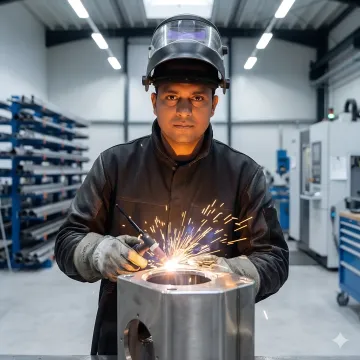
We employ multiple advanced welding technologies including TIG (GTAW) welding, laser welding, micro-plasma welding, micro-cladding, and hybrid welding processes. The optimal process is selected based on material type, component geometry, tolerance requirements, and production volume to ensure the most economical and technically appropriate solution.
Can you handle both prototype and production welding?
Yes. We support the full manufacturing lifecycle from initial prototype welding and R&D development through small-batch production and large-volume manufacturing. Our flexible process capabilities and dual-facility operation enable rapid turnaround for prototypes while maintaining consistent quality for production runs.
What industries do you serve for welding and fabrication?
We serve automotive manufacturing, aerospace and defense, medical device production, tool and die manufacturing, pressure die casting, plastic injection moulding, rubber moulding, heavy equipment fabrication, and precision instrumentation sectors where weld quality and metallurgical integrity are critical.
How do you ensure welding quality and consistency?
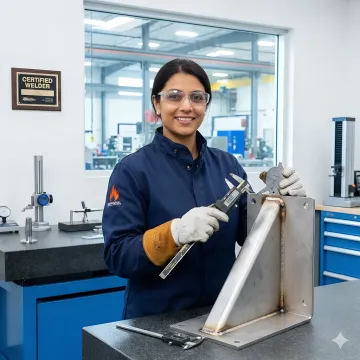
Every weld is executed by AWS-certified welders following documented welding procedures. We maintain an average defect rate of less than 1% through rigorous process controls, pre-qualified welding parameters, and comprehensive inspection protocols before delivery. Critical components undergo dimensional verification and quality certification.
What is the typical turnaround time for welding projects?
Turnaround times vary based on component complexity, weld requirements, and production volume. Prototype and urgent repair work can often be completed within days, while larger fabrication projects are scheduled based on technical requirements. We provide delivery estimates upfront during the quotation stage.
Can you repair damaged or worn industrial components?
Absolutely. We specialize in restoration welding for damaged moulds, dies, cutting tools, and precision components. Using controlled material deposition techniques, we rebuild worn surfaces, repair damaged features, and restore tools to original tolerances, dramatically extending service life at a fraction of replacement cost.
What are the size and weight limitations for components you can fabricate?
We have no practical size or weight limitations, handling components ranging from 50 grams to over 20 tons. Our dual-facility operation in Bengaluru and Pune is equipped to accommodate miniature precision parts as well as large industrial assemblies without restrictions on complexity, shape, or configuration.