Can TIG welding be automated?
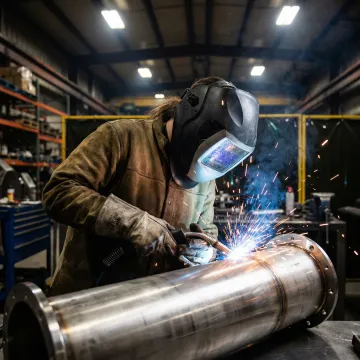
Yes, TIG welding can be automated using robotic systems or mechanized equipment for repetitive, high-volume applications. However, many critical aerospace, defense, and precision components still require manual TIG welding by certified welders to accommodate complex geometries, varying joint configurations, and real-time parameter adjustments that ensure optimal weld quality and metallurgical properties.
Is a TIG weld stronger than a MIG weld?
TIG and MIG welds can achieve comparable strength when properly executed, but TIG welding typically provides superior weld quality with better penetration control, cleaner weld profiles, and minimal porosity. TIG is preferred for critical applications requiring exceptional structural integrity, tight tolerances, and clean appearance, while MIG offers faster deposition rates for structural and production welding applications.
How many amps to TIG weld stainless steel?
TIG welding amperage for stainless steel depends on material thickness, joint configuration, and welding position. Generally, use 30-40 amps per 1mm (0.040 inch) of material thickness. For example, 2mm stainless steel typically requires 60-80 amps, while thicker sections may need 150-200 amps. Our certified welders optimize parameters based on specific application requirements to ensure proper penetration and weld quality.
What welding processes does Wintegral Engineering offer?
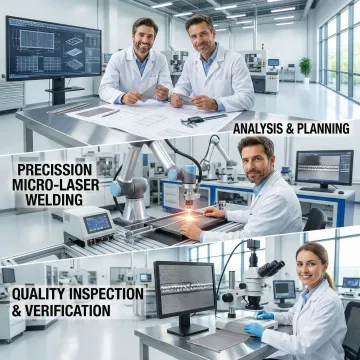
We provide comprehensive welding capabilities including TIG (GTAW), Micro TIG, Laser Welding, Micro-Plasma Welding, MIG (GMAW), Micro-Cladding, and proprietary Hybrid Welding processes. This multi-process approach allows us to select the optimal technology for each application, ensuring economical repairs, superior quality, and precise control for components ranging from delicate medical devices to heavy industrial tooling.
What materials can you weld?
Our advanced welding capabilities cover stainless steel, aluminum, titanium, tool steels (H-13, H-21, P-20, D2, M2, S7), carbon steel, copper, beryllium copper, and specialized alloys. We work with materials across thickness ranges from ultra-thin sections (micro-welding) to heavy industrial components, selecting appropriate filler materials and procedures to ensure metallurgical compatibility and structural integrity.
Do you provide onsite welding services?
Yes, we offer onsite welding and repair services for moulds, dies, and components that cannot be easily transported or require immediate attention to minimize production downtime. Our mobile welding teams bring appropriate equipment and expertise directly to your facility, performing repairs with the same quality standards and documented procedures used in our Bengaluru and Pune welding studios.
What industries do you serve?
We serve diverse industrial sectors including automotive manufacturing, aerospace and defense, medical device production, plastic injection moulding, pressure die casting, rubber moulding, precision machining, tool and die manufacturing, R&D laboratories, and general precision engineering. Our multi-process capabilities and technical expertise enable us to support applications from prototype development through high-volume production welding.
What is your typical turnaround time for welding services?
Turnaround times vary based on component complexity, welding process required, and current workload. Simple repairs and precision welding jobs typically complete within 3-7 business days, while complex tool restoration or large-scale projects may require 1-3 weeks. We provide realistic delivery estimates upfront and prioritize urgent repairs to minimize your production downtime and support critical manufacturing schedules.